Empire of Chains is officially released!

Today marks the release of Empire of Chains. This is a day I’ve been looking forward to, and dreading, for a long time. This book has been with me in many forms since I was 15 years old (I’m now 27, for the record). When I first wrote this book (and series), it was not very good, and that’s a nice way of putting it.

But in the 12 years since, I have grown as a writer. I’ve written other stories, but this one has always held a special place in my heart. A lot of the initial setting details and the main characters have remained mostly the same, but pretty much everything else in the series is much different from what I originally wrote.

And much better, I should add.

Originally, I wrote a cliche-riddled story about heroes going on a quest to defeat a dark lord. Since then, that story has evolved. There’s still a quest, but it’s not as much of a focus. There’s still a dark lord figure, but he’s not really a dark lord. In fact, from his perspective, he’s a hero. He does terrible things, but they’re all in the name of creating a better future.

You’re probably wondering why you should read this. First and foremost, it’s classic fantasy updated for modern audiences. As a reader, I enjoy the feel of series like The Wheel of Time and authors like Brandon Sanderson. Sanderson, especially, takes a lot of the common fantasy tropes and puts his own spin on them. That’s what I like to do in my books as well. I want to write the kind of stories that made me fall in love with fantasy in the first place, but I also want to make them feel new and fresh. I like stories with a lot of action and magic, and with characters who I can root for. If you’re looking for Grimdark, I’m probably not the author for you. I do include some dark elements in my work, and there is a fair amount of death in my stories, but I’d say I write more PG-13 fantasy.

There’s some mild language, fade-to-black sex scenes, and a fair amount of violence. But I think anyone from about age 12 and up can read my books (possibly even younger depending on the maturity and reading level of the child in question).

This is deliberate on my part because I also write young adult and middle grade fantasy. I don’t currently have any in the works, but I do love writing for those age groups, and I wouldn’t want my younger readers to read my other books and find they’re not appropriate for their age group.

In this regard, I’d say my target audience is a lot like Brandon Sanderson’s in terms of age and interests. I’m not claiming to be Brandon Sanderson. Id love to be held in the same regard someday, but right now, I’m just another self-published writer trying to find his way in a crowded field.

I hope you’ll take the chance on my series, and if you enjoy it, please do leave reviews on Amazon and Goodreads. Also tell your friends and family. Word of mouth is the self-published author’s best friend, whether that’s telling someone in person or leaving reviews online.
Series Review: The Dragon Brigade by Margaret Weis and Robert Krammes

I recently finished the final book in this trilogy, and it was an enjoyable ride. I’ve read Weis’s work before. I enjoyed the original Dragonlance trilogy, though it is pretty cliched stuff by today’s standards. Her Death Gate Cycle (also with Tracy Hickman) was one of those series that I really grew to love by the end. It was similar to Dragonlance in some ways, but it showed more depth and an interesting world (or rather, multiple worlds).

This series has a very different feel. It’s a world of magic and airships and dragons. Most notably, it does not have the generic Tolkienesque/D&D races that I’ve come to expect from Weis. That, for me, was a major bonus. I don’t hate these races by any means, but I rarely see them done in a way that feels fresh.

I’ve always felt the biggest strength of Weis and her various partners (from what I’ve read) is creating characters that are fun to read about. This series is no exception. I loved the dynamics between friends Stefano and Rodrigo. The priest, Father Jacob, was also a lot of fun to read about.

Description of the first book (from Goodreads):

“The known world floats upon the Breath of God, a thick gas similar to Earth’s oceans, with land masses accessible by airship. The largest of these land masses are ruled by the rival empires of Freya and Rosia. Magic is intrinsic to the functioning of these societies, and is even incorporated into their technological devices. But now a crucial scientific discovery has occurred that could destroy the balance of power-and change the empires forever.”

I’m personally not a fan of this description. It’s a bunch of worldbuilding without giving us much about plot or character. The world is fun, but there’s a lot more to the series than that.

My reviews of each book:

BOOK 1:

“Overall, this was a very enjoyable mixture of Steampunk and High Fantasy. The start was a bit slow, but there was a lot of great action in the last two thirds of the book. The writing is nothing special, but that didn’t bother me. I found myself connecting with the characters. It’s nice to see authors who still like their heroes on the heroic side.

Weis has worked both alone and with co-authors during her career. I haven’t read all her stuff, but I’d say this is probably the best first book in a series I’ve read by her. The Death Gate Cycle comes in second while Dragonlance is a distant third.

This one did recycle some ideas from the Death Gate cycle, but that didn’t bother me. This one is definitely more modern in feel. I also like that it’s a Gunpowder fantasy. It’s kind of nice to see a mixture of guns and dragons (and airships).

Overall, I recommend this book for readers who are looking for something that will hit the same spot as Chris Wooding’s Ketty Jay series and Jim Butcher’s Cinder Spires. While it’s not as good as either of those series, I enjoyed it.”

Rating: 8/10

BOOK 2

“This was an enjoyable book, probably on par with the first in the series. The characters are fun, the world is interesting, and there’s some good action. These books don’t quite make it into my list of favorites, but I still enjoy them quite a bit.”

Rating: 8/10

BOOK 3

“I really liked this conclusion to the Dragon Brigade trilogy. The final battle was very epic, and I enjoyed spending time with these characters throughout the trilogy. This series is loaded with action, airships, floating islands, and fun characters. It’s a testament to the fact that Weis can write good stories outside of her Dragonlance work.”

Rating: 9/10

Overall, I’d give the series an 8.5. It’s nothing complex, but it was fun to read, and a lot of times, that’s all I’m looking for.

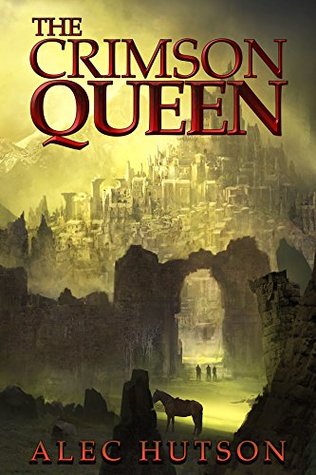
SPFBO Book Review: The Crimson Queen by Alec Hutson

This is my first review of a fellow Self-Published Fantasy Blog Off participant. I actually picked this book up before it was entered into the competition, but I just finally got around to reading it. I’m glad I did.

33237983


Here’s the description:

Long ago the world fell into twilight, when the great empires of old consumed each other in sorcerous cataclysms. In the south the Star Towers fell, swallowed by the sea, while the black glaciers descended upon the northern holdfasts, entombing the cities of Min-Ceruth in ice and sorcery. Then from the ancient empire of Menekar the paladins of Ama came, putting every surviving sorcerer to the sword and cleansing their taint from the land for the radiant glory of their lord.

The pulse of magic slowed, fading like the heartbeat of a dying man.

But after a thousand years it has begun to quicken again.

In a small fishing village a boy with strange powers comes of age…

A young queen rises in the west, fanning the long-smoldering embers of magic into a blaze once more…

Something of great importance is stolen – or freed – from the mysterious Empire of Swords and Flowers…

And the immortals who survived the ancient cataclysms bestir themselves, casting about for why the world is suddenly changing…

The first book in The Raveling, a new epic fantasy saga

Here’s my review:

This was a very good beginning to a series and author I’ll be watching closely. It’s classic fantasy done very well. Fans of The Wheel of Time will find a lot to like here. It isn’t a copy by any means, but it gives the same vibe.

The best thing about this book is the sense of mystery throughout. You get the feeling that there is always something more beneath the surface of every interaction, every place in the world, every revelation. That sense of mystery propelled me through the book.

The characters are mix of the likeable (Keilan, Nel and Xin), the conflicted (Senacus), and the mysterious (Jan and Alyanna). This mixture in the characters really worked for me because it provided a lot of variety and had me interested in every point of view.

I’m not sure what to expect from the magic of this world yet. A lot of it still remains a mystery, but that’s okay. There are definitely a lot of competing factions, both magical and non-magical, that make things interesting. You have immortal sorcerers, demons, magical assassins, paladins that hunt sorcerers. It has a lot of the great ingredients that make me love a fantasy book.

It also had some good action scenes. There weren’t a lot of them, but they were good when they did happen. I won’t quite put them up there with my favorite action scenes, though. I also thought at times that Hutson got a bit too descriptive, but that’s about my only major complaint with this one.

Rating: 9/10

Sunweaver Book 3 is finished.

I have now completed the first draft of my entire Sunweaver series. That’s on top of having my entire World in Chains series written. That means that my readers can expect both series over the course of the next year, once I edit and get cover art.

I had an 8,000 word sprint today to finish Sunlord, the third book in the trilogy. It had one of my favorite action sequences yet to conclude the book, and the book is pretty action-packed throughout. I’m excited to get to work on editing it, though that will likely wait awhile because I still have to edit the last three books of World in Chains.

I will probably take a short break from writing. I usually do that after finishing a book to give me just a little time for the creative juices to recharge. I’m not sure which project will be the next one. I may do a few trial runs with my various ideas and see which one grabs me the most.

The God War is one of my series, and I have written the first draft of the first book. I’m anticipating it being three books long, just like Sunweaver, so that may be where I go next. But I also have another series I’ve started that I’m really excited about. It’s so tough to make these decisions sometimes.

An Update: Sunweaver Book 3, World in Chains edits, and some random thoughts on writing huge epics.

I’m 71,000 words into the final book of my Sunweaver trilogy. Things are really shaping up nicely as I approach the end. I expect the book to be somewhere between 100,000 words and 110,000 words, making it roughly the same length as the first two in the series.

I’m also busy editing Book 2 of World in Chains. I hope I can get that one in good enough shape to have it out toward the end of the summer or in the early fall. I’ve written the entire series, which is what I plan to do for all my series at the moment.

I may come to a point where I have a series that’s too long for that method to work. Somewhere in the back of my mind, I have Wheel of Time style epics swimming around. I don’t know if I’ll ever get around to writing them, and when I do, they might be shorter series to begin with. I don’t get quite as epic in my word count as some epic fantasy authors. The longest of any of my books is the first draft of World in Chains book 4, which stands at about 170,000 words. That’s nothing compared to one of Sanderson’s Stormlight Archive books.

Within the next week, I should begin the cover art process for Empire of Chains. Hopefully that all goes smoothly, and I have the cover ready by the end of the month. In the meantime, I will likely run through the book a couple more times to check for any typos that have eluded me this long.

Why I stopped outlining.

In the plotter vs. “pantser” (one who writes by the seat of their pants) debate, I used to be firmly on the plotter side. I’m generally a structured person, or at least more structured than a lot of creative types. I’m an Electrical Engineering student in addition to being a writer, so I use a lot of my left brain.

Because of that, I always thought I should outline my books. At times, this has worked for me, but I’ve discovered more and more that I get my best ideas as I’m in the flow of the story. Outlining is an entirely different process. I don’t quite feel the story the same way, and my ideas are less inventive.

This becomes especially clear when I write series. The farther I get into writing a series, the more likely I am to deviate from my original outline. I got to the point where I was doing this so much that I decided I should just throw out the outline altogether.

However, that might be too extreme of a response. I don’t quite make up everything as I go. I form a mental outline. I know where I want to get, but if I discover something more interesting along the way, I’m perfectly happy to alter my mental plans.

This can lead to some inconsistencies between books, and that’s part of the reason I’ve decided that I will generally write an entire series before publishing any of it. That way, if I introduce something important in book 3 or 4, I can go back and throw in some hints toward it in book 1. A lot of planners are able to do this kind of thing because they outline the entire series in advance. I’ve tried, and it simply doesn’t work like that for me.

When I was considering trade publishing, I always had issues with throwing away the outline because trade publishing tends to work differently. You rarely write the entire series before publishing any of it. I know Michael J. Sullivan (author of the very good Riyria Revelations, Riyria Chronicles, and Legends of the First Empire series) does this. But he did start out self-publishing.

Now that I’ve decided to go with self-publishing, I can write my series however I want, and writing them this way helps me to give you a plot with a lot more interesting twists and turns.

That’s not to say I throw away the outline completely. I’ve been known to outline a few chapters ahead of where I am. That can help me write more quickly during my writing sessions because I’m not figuring out what’s going to happen next. More often, my mental outline is good enough to carry me through, and I’m able to figure out the details as I write.

The key thing as a writer is finding a process that works for you. This process works for me right now. In the future, I may decide to go back to outlining. I don’t think you should ever get stuck thinking there’s only one way to write that works for you. Writing is a continual process of experimentation, and every story is going to have different needs.

Book Review: Hope and Red by Jon Skovron

I’m going to try to get back into reviewing books. I’ll probably review some big names from time to time, but I’m hoping I can get in more reviews of some of the lesser-known authors out there (both in trade publishing and self-publishing).

In that spirit, I will start with a review of Hope and Red by Jon Skovron. This one immediately caught my attention when I first heard of it because it sounded like something Brent Weeks would write.

You have two main characters. One of them is a young woman who, as a girl, was the only survivor of a sorcerous attack on her village performed by the emperor’s Biomancers. These Biomancers like to experiment on people, and the empire largely turns a blind eye to these experiments, which are quite disturbing.

These Biomancers were one of my favorite things about the book. It’s a type of magic you don’t see as often in fantasy, and it made me feel that I’d be getting more than just a Weeks clone.

The girl, who comes to be called Hope, ends up being sent to an island where an order of warrior monks lives. The leader of these monks trains her even though they are not supposed to train women, and she becomes quite a force.

The other main character is a charming young rogue who goes by the name Red, on account of the red eyes he gained as the survivor of his mother’s drug addiction. In addition to being a thief, he’s also quite the artist. He comes to play a major role in a slum within one of the empire’s largest cities.

As you can probably guess, their stories end up coming together. Along the way, there’s plenty of action, some good bits of humor, and characters that you want to root for despite their flaws.

It’s also another in the growing list of gunpowder fantasy you see these days. It’s nice to see more and more fantasy moving away from its quasi-medieval roots. Don’t get me wrong. I love a lot of fantasy novels with that setting, but it’s also refreshing to see more varied settings.

I never quite got that feeling I get reading my favorite authors, but this was a very good adult fantasy debut for an author who has written some young adult before. I recently read the second book, and it continues the story quite well, throwing in some interesting new wrinkles.

Rating: 8.5/10

Self-Publishing and Reading Habits

When I first decided to get serious about writing, I got serious about reading. I looked for all the best that fantasy and science fiction had to offer. At first, this was entirely in the realm of trade publishing. I didn’t think there was anything worthwhile apart from that, or I thought it would be too difficult to find it. But since I’ve become more involved in the SFF community online, I’ve found quite a few self-published novels that I’ve enjoyed.

Now, as I’m embarking on my own self-publishing career, I’m wondering just how much I should read of self-published vs. trade-published books. I find a lot of books I enjoy in both arenas, and some I don’t.

I’m considering reading a lot of the novels by my fellow Self-Published Fantasy Blog Off entrants. I’m not sure how well I can commit to that, however. So far this year, I’ve read only 24 books, and some of them have been quite short.

I used to be a much more voracious reader, but now that I have my own writing career and Engineering school to keep me occupied, I’m not finding as much time to read. That brings me to the following question: Should I focus on all the trade-published fantasy series I want to read, or should I focus on giving my fellow Indies a chance?

I don’t know the answer. In the end, I think it comes down to reading the books that interest me most without paying any attention to how they were published.

Those are my thoughts. What do you think?

As a side note, my website may not be working correctly at the moment. I changed my domain name when I upgraded my WordPress account. They said it may take up to 72 hours before my site functions perfectly.

Fantasy Book Review: The Way of Kings by Brandon Sanderson

I’m trying to get more active with this blog, so I’m going to go through some of the various book reviews I’ve written. Next up is one of my favorite authors: Brandon Sanderson

I read The Way of Kings quite a while ago. In fact, it’s been almost five years since I’ve read it, so this won’t be too heavy on plot details. Besides, I don’t like to spoil to many things anyways.

This book is a good beginning to the Stormlight Archive, which looks like it will turn out to be Sanderson’s magnum opus. It’s a huge world with a huge story (more than 1000 pages of it, in fact). There’s a lot of good about this book, but at the same time, it’s setting up a much more massive story. Some of Sanderson’s other stuff stands alone (Elantris, Warbreaker, the first Mistborn book). This does not.

It’s also a major time investment and requires you to trust the author before you tackle it. I suggest reading some of his other works first. They’re not as deep and complex as this, but they’re also faster-paced and serve as better introductions to his work.

Now for the good:

This is a highly interesting and complex world. There’s the threat of an apocalyptic war. There are fierce storms that shape geography and wildlife. There’s conflict between and within nations. On top of all that, you have Sanderson’s great magic, though you should be warned that the magic in these books is a bit more mysterious than you’ll find in Mistborn. I’m sure there are rules for it, but it’s been missing for a long time, and so when it does show up, the characters are still figuring it out.

That brings me to the characters. In this book, Sanderson has crafted some of his best characters. Kaladin makes an interesting and conflicted protagonist. Shallan is annoying at times, but she grows on you as you read (and especially in the second book).

I especially found myself absorbed in Kaladin’s struggles. Some of the things he has to endure are truly horrific, and his character journey is a fascinating one to watch.

There’s also a great deal of mystery in these books. Since it’s the first of a ten-book series, you don’t get as many answers as you normally get from Sanderson. I found this mystery added to the book and helped me get through some of the slower sections.

Don’t worry. There is action. Great action. You just have to wait a while for it.

This book continues one of the things I love about Sanderson’s work. He’s not afraid to use common fantasy tropes. He just put his own spin on them. In doing that, he gives the reader something that’s both familiar and different, and that’s the right balance for me. If you’re looking for something that completely avoids tropes, this isn’t the right story for you.

For me, it’s the kind of story that reminds me of why I fell in love with fantasy in the first place. Sanderson writes the modern update of classic fantasy that keeps most in touch with the roots of the genre.

In all, this was a very good book, but it did have its slow sections. For those who are interested, I thought Words of Radiance was truly excellent.